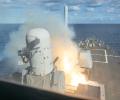
In a coordinated military operation, the United States and Israel launched airstrikes against Iran, escalating tensions amid stalled nuclear talks and claims of resumed nuclear activities, resulting in the death of Iran's supreme leader.

US President Donald Trump is set to provide an "operational update" on the progress of 'Operation Epic Fury' during a national address scheduled for 9 PM Wednesday (US local time).
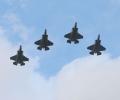
A Congressional Research Service report reveals that at least 42 US aircraft were lost or damaged during Operation Epic Fury, targeting Iran, with costs estimated to reach USD 29 billion.

Rescue operations are currently underway, and the circumstances surrounding the incident are under investigation, the command said.

In his first major national address since hostilities began, Trump said the ongoing military campaign, dubbed 'Operation Epic Fury', has delivered 'swift, decisive, overwhelming victories'.

The United States has paused a proposed USD 14 billion arms sale to Taiwan due to concerns about maintaining sufficient munitions for potential conflicts, particularly in light of the ongoing situation with Iran.

The United States used an array of weapons in the strikes conducted against Iran as part of Operation Epic Fury on Saturday -- which included artificial intelligence services from Anthropic, according to a report by Reuters.

White House Press Secretary Karoline Leavitt on Tuesday said that the United States has not ruled out the option of sending troops on the ground in Iran and that military operations in the Persian Gulf nation would end once the objectives of Operation Epic Fury are achieved.

Trump emphasised that diplomatic discussions remain ongoing. At the same time, he issued a stark warning, saying that failure to reach an agreement could trigger military action.

The USS Abraham Lincoln has been operating in the Arabian Sea since the end of January.

United States President Donald Trump warned Iran of potential strikes on its infrastructure, including bridges and electric power plants, saying the US military 'hasn't even started destroying what's left in Iran'.

US Secretary of War Pete Hegseth on Wednesday claimed that Tehran "begged" for a truce, maintaining that Washington achieved a "decisive military victory" during 'Operation Epic Fury.'
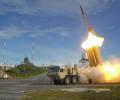
The US has reportedly depleted nearly half of its advanced missile-defence interceptors while defending Israel during recent hostilities with Iran, raising concerns about future readiness.

The USS Tripoli, carrying around 3,500 US Marines, has entered the United States Central Command (CENTCOM) area of responsibility, marking the deployment of one of America's largest amphibious assault ships into an active combat theatre in West Asia amid the ongoing conflict.

Admiral Alireza Tangsiri was accused of leading efforts to disrupt maritime trade, including actions affecting the Strait of Hormuz.

Indian benchmark indices, Sensex and Nifty, rallied significantly following a sharp decline in crude oil prices. This decline was triggered by US President Donald Trump's announcement of progress in negotiations with Iran towards a peace agreement, which led to renewed optimism in global markets.

Indian benchmark indices, Sensex and Nifty, saw a significant rebound in early trade, driven by a decline in crude oil prices. This drop followed US President Donald Trump's announcement of progress in negotiations with Iran towards an agreement to end the war, leading to a temporary pause in 'Project Freedom' to escort ships through the Strait of Hormuz. Track Nifty 50 and BSE Sensex performance and key global triggers.

Trump also asserted that US forces had struck hundreds of targets across Iran, including facilities of the Islamic Revolutionary Guard Corps and air defence systems.

Iran's state media cited the spokesperson for the Central Headquarters of Iran's military to claim that a United States military refuelling plane was shot down by a missile fired by resistance groups in western Iraq. The spokesperson further told Press TV that all six service members on board had been killed.

Amid ongoing ceasefire negotiations, Israel is on high alert, fearing a potential surprise missile and drone attack from Iran targeting Gulf countries and Israel, according to intelligence officials.

The United States has redirected 48 vessels in the Persian Gulf, particularly in the Strait of Hormuz, over the past 20 days amid ongoing enforcement actions related to restrictions on Iranian maritime assets by the US Navy.

Hegseth said the military campaign, code-named Operation Epic Fury, against Iran is "laser focused" and "decisive," with objectives set directly by the US administration remaining unchanged since the start of operations.

Iran's claim comes after United States President Donald Trump confirmed that the military rescued the second F-15 crew member, who had gone missing after Iran downed the jet amid the West Asia conflict.

It remains unclear whether United States President Donald Trump or Iranian authorities will pursue the offer.

He also warned the Gulf countries, which are allowing the US to launch an attack from their soil, vowing to "punish" the regional partners.

While Trump described the operation as the 'most daring' search and rescue mission in US military history, Iran termed it a victory, claiming it shot down a C-130-class aircraft involved in the operation.

Italy has denied the United States the use of the Sigonella military base for flights heading to West Asia, citing a lack of consultation and concerns over the nature of the flights. This decision reflects Italy's stance on avoiding escalation in the region, as Prime Minister Giorgia Meloni's government emphasises its desire to stay out of war.

US forces have launched search and rescue efforts for a US fighter jet, which several news outlets, including the Wall Street Journal and CNN, said had been shot down over Iran.

Media reports based on intelligence sources say nearly half of Iran's missile launchers remain intact, while thousands of one-way attack drones are still part of its arsenal even after continuous strikes targeting military infrastructure over the past five weeks.

US President Donald Trump's proposed peace deal with Iran has drawn significant criticism from both Republican and Democrat senators, who express deep concerns that it would legitimise Tehran as a 'dominant force' and potentially allow it to retain control over the Strait of Hormuz and uranium enrichment capabilities.
In a post on Truth Social, Trump outlined key goals of the campaign, including degrading Iran's missile capabilities, dismantling its defence industrial base, eliminating naval and air power, preventing Tehran from acquiring nuclear capability, and protecting United States allies such as Israel, Saudi Arabia and the United Arab Emirates.

In a testimony before the Senate Intelligence Committee, Gabbard, the Director of National Intelligence, also said that the threats to the US were set to expand collectively from more than 3,000 missiles at present to more than 16,000 missiles by 2035.

A lesson for India is to clearly define objectives beforehand, so that the adversary or other parties do not attempt to mitigate them midway.
Amidst escalating tensions in West Asia, Iran claims to have inflicted heavy casualties on US forces in Dubai, a claim vehemently denied by the US Central Command, raising concerns about regional stability.

According to an official Iranian military statement, Qader anti-ship cruise missiles were launched at the carrier, forcing it to alter its position in the region.
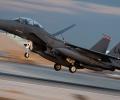
The military command clarified in a statement published on X that the aircraft were engaged in error during active combat operations on Sunday.
China has called on Iran to reopen the Strait of Hormuz and expressed appreciation for Tehran's commitment not to develop nuclear weapons, a key demand of the US to end the conflict.

The United Arab Emirates Ministry of Defence has announced that the air force and air defence forces have successfully intercepted a significant number of aerial threats following a large-scale Iranian attack that commenced on February 28.
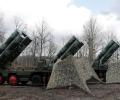
In Operation Sindoor, Pakistan had deployed additional squadrons of the Chinese-origin HQ-9 air defence systems, which could not do much against the Indian aircraft when they brought down multiple terror targets inside Pakistan.

Srivastava warned that continued bombing of Iran by the US and Israel could severely undermine any prospects of reopening critical maritime routes through negotiation with Tehran.
